
 create new ticket
 check ticket status
Department Items allow you to charge your Customers for different functions that are necessary to produce a job.
The Department Item window consists of two sections Configuration and Pricing.
In this article we will be focusing on specific fields that will get you up and running from a pricing standpoint.
A full breakdown of Department Item functionality can be found here - Learn more about Department Items
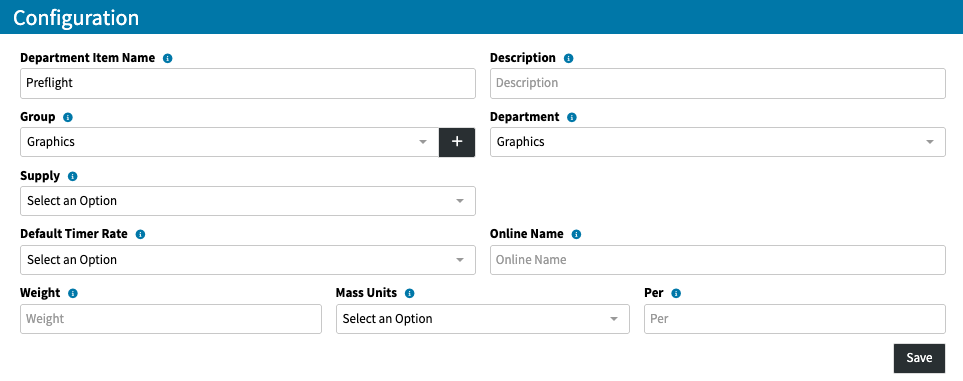
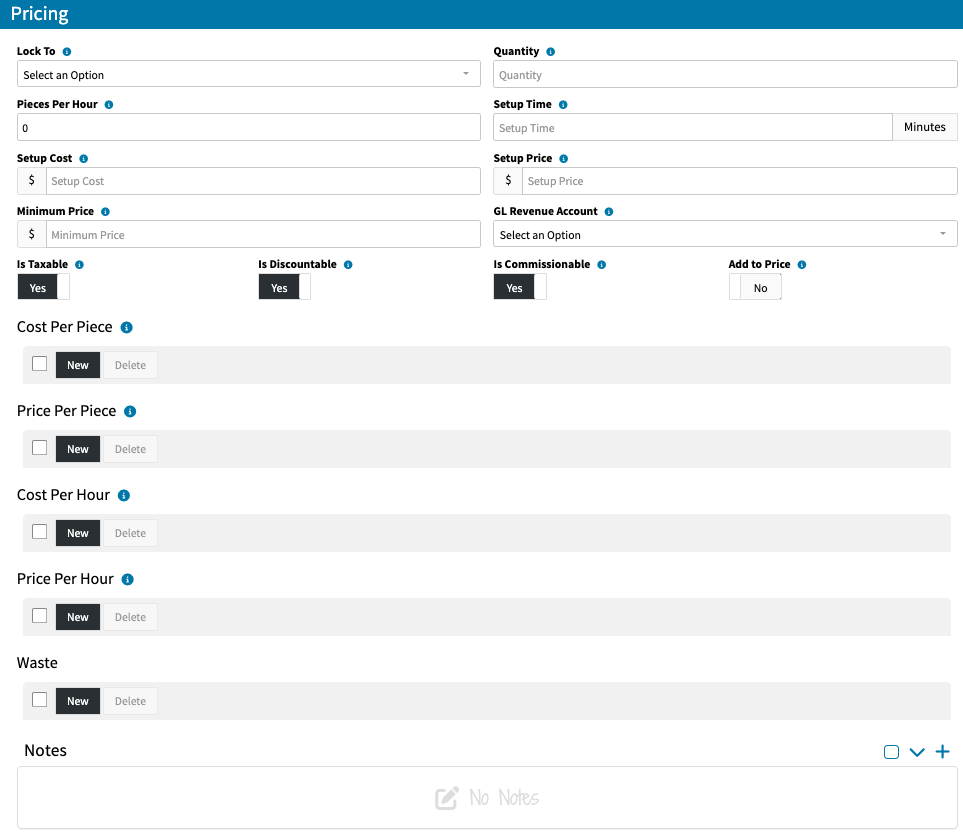
Create a Static Department Item - Preflight
Settings > Dockets > Department Items > {New}
Configuration
- Enter a Name for this charge such as Preflight
- In the Group dropdown select Graphics
- In the Department dropdown select Graphics
- Click Save
Pricing
- Lock To - Leave as "Select an Option"
- Quantity - Enter a 1
- Setup Cost - Enter the internal cost for the preflight charge (not required)
- Setup Price - Enter the amount that you charge your customers for preflight
- Click Save
By leaving the Lock To as Select an Option and entering a 1 in the Quantity field, the system will charge the Setup Price regardless of any other variables on a quote or order item. This method is suitable for Preflight, Make Ready, Proofing and other charges that are charged once.
Create a Price Per Piece Department Item - Binding
Settings > Dockets > Department Items > {New}
Configuration
- Enter a Name for this charge such as Coil Binding
- In the Group dropdown select Finishing
- In the Department dropdown select Finishing
- Click Save
Pricing
- Lock To - From the dropdown select Quantity
- Setup Cost - Enter the internal setup cost for the binder charge (not required)
- Setup Price - Enter the amount that you charge your customers for the binder setup (not required)
- Cost Per Piece - The internal cost to bind a book
- Price Per Piece - The price you charge to bind a book
- Click Save
By choosing Quantity as the Lock To, the system will charge the Setup Price and then multiply the Quantity field of a quote or order item against the Price Per Piece. This method is suitable for Coil Binding, Saddle Stitching, and other charges that are priced out specific to the Quantity field when you want to charge per piece.
Create a Price Per Hour Department Item - Binding
Settings > Dockets > Department Items > {New}
Configuration
- Enter a Name for this charge such as Coil Binding
- In the Group dropdown select Finishing
- In the Department dropdown select Finishing
- Click Save
Pricing
- Lock To - Select Quantity
- Pieces Per Hour - Enter the number of books you can bind per hour
- Setup Cost - Enter the internal setup cost for the binder charge (not required)
- Setup Price - Enter the amount that you charge your customers for the binder setup (not required)
- Cost Per Hour - Internal cost per hour (not required)
- Price Per Hour - Price you charge your customers per hour
By choosing Quantity as the Lock To, the system will charge the Setup Time against the Price Per Hour and then divide the Quantity field by the Pieces Per Hour field and then multiply by the Price Per Hour field. This method is suitable for Coil Binding, Saddle Stitching, and other charges that are priced out specific to the Quantity field when you want to charge per hour.
Create a Price Per Piece and Per Hour Department Item - Binding
Settings > Dockets > Department Items > {New}
Configuration
- Enter a Name for this charge such as Coil Binding
- In the Group dropdown select Finishing
- In the Department dropdown select Finishing
- Click Save
Pricing
- Lock To - Select Quantity
- Pieces Per Hour - Enter the number of books you can bind per hour
- Setup Time - Enter the time that it takes to set up this operation
- Cost Per Piece - The cost of the coil binding material
- Price Per Piece - The marked up price of the coil binding material
- Cost Per Hour - The internal cost per hour for the labor of binding the books
- Price Per Hour - The price you charge per hour for the labor of binding the books
This option works really well if you are looking to separate the material costs from the labor rate to perform the action of binding.